
Power of buyers and suppliers
by Divya Kolmi
1/12/20263 min read
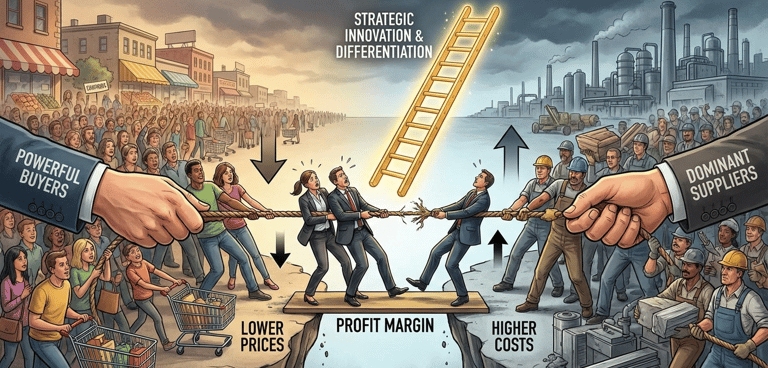
Most people think business strategy is about beating competitors. But in reality, competition is only part of the story. The real battle happens vertically between buyers on one side and suppliers on the other.
You are not just competing with the company next door. You are negotiating with:
Suppliers, who control your inputs, and
Buyers, who control your revenue.
If you don’t understand the power dynamics at both ends, you’re not really running a business - you are simply passing value from one powerful player to another.
1. The Power of Buyers: The Demand-Side Ceiling
Powerful buyers place a ceiling on how much money you can make. When buyers have leverage, they can push prices down, demand better quality, or force additional services often without paying more.
Buyer power increases when:
Buyers are large and concentrated
Products are standardized or undifferentiated
Switching costs are low
In these cases, buyers can easily walk away.
The Commodity Trap
Consider the 'agricultural industry'. A farmer growing standard yellow corn has almost no pricing power. The product is identical across farms, so buyers, large food processors like ADM; can switch suppliers instantly.
If one farmer raises prices even slightly, the buyer simply purchases from another farm. The farmer becomes a price taker, not a price maker.
The Strategic Pivot: Differentiation
To escape buyer power, firms must differentiate.
A great example is Glass Gem Corn. This isn’t just corn, it’s visually striking, rare, and emotionally appealing. Because it’s unique, buyers can’t easily replace it with another product. That uniqueness turns a commodity into a niche monopoly.
The lesson is simple:
If buyers see your product as interchangeable, they control you.
If they see it as unique, you control the terms.
Example: The “Walmart Effect”
Many small consumer goods companies face what’s known as the concentrated buyer problem. If 30–40% of your revenue comes from Walmart, Walmart is no longer just your customer, it’s your boss. They can demand:
Lower prices
Faster delivery
Changes in packaging
Because products like soap or toothpaste are standardized, Walmart’s switching cost is close to zero. But for the supplier, losing Walmart could mean bankruptcy. This imbalance gives the buyer enormous power.
2. The Power of Suppliers: The Input-Side Floor
While buyers limit how much revenue you can earn, suppliers determine how high your costs can go. This creates pressure from the bottom.
Supplier power increases when:
Suppliers are few and concentrated
Inputs are specialized
Switching suppliers is expensive
The Aviation Industry: A Supplier Duopoly
The airline industry is a textbook example of supplier power. There are hundreds of airlines globally, but only two major suppliers of large commercial aircraft: Boeing and Airbus. This imbalance gives suppliers significant leverage.
An airline can’t easily switch from Boeing to Airbus because doing so requires:
Pilot retraining
New maintenance systems
Different spare parts and infrastructure
These high switching costs lock airlines into long-term relationships, strengthening supplier power.
The Threat of Forward Integration
Suppliers become especially powerful when they can credibly say: “I don’t need you—I can sell directly.”
A classic example is Intel. Originally just a chip supplier, Intel strengthened its position by branding itself (“Intel Inside”) and becoming more recognizable than many computer manufacturers. By doing so, Intel ensured long-term relevance and bargaining power.
Strategic Defense: How Firms Reclaim Power
To survive this vertical squeeze, companies must actively rebalance power. Three strategic moves are especially effective.
1. Reduce Buyer Power Through Stickiness
Instead of selling just a product, sell an ecosystem.
For example, when a company stores its data in a specific software platform, switching becomes costly and risky. Even if a competitor offers a lower price, the buyer may stay because leaving would disrupt operations.
High switching costs weaken buyer power.
2. Reduce Supplier Power Through Multi-Sourcing
Never rely on a single supplier for a critical input. By working with multiple suppliers, firms:
Avoid dependency
Gain negotiation leverage
Reduce risk
When suppliers know they can be replaced, power shifts back to the buyer.
3. Use the Threat of Integration
Sometimes, power is reclaimed by threatening to make the product in-house. Netflix is a strong example. Initially dependent on Hollywood studios for content, Netflix began producing its own movies and shows. This reduced supplier power and gave Netflix control over its core asset - content.
Profitability is not accidental. It comes from strategic positioning - placing yourself where:
Suppliers are many and weak, and
Buyers see your product as unique and irreplaceable
If you can’t clearly articulate what makes your product different - your own version of Glass Gem Corn - then you’re just selling yellow corn.
And in that game, the buyer always wins.
Explore More Business Articles
Contact
Questions? Reach out anytime.
© 2025 BizSphere. All rights reserved.