
Porter's Five Forces Model
by Divya Kolmi
12/17/20253 min read
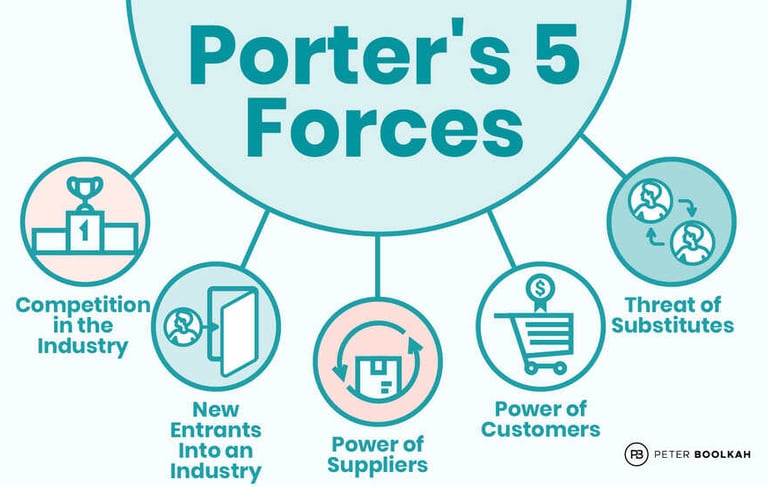
Porter’s Five Forces framework is a valuable tool for assessing the competitive dynamics within an industry. It is particularly beneficial for entrepreneurs considering launching a new business or entering a different sector. This model posits that competition is influenced by five key forces: the threat of new entrants, the bargaining power of suppliers, the bargaining power of buyers, the threat of substitute products or services, and the intensity of rivalry among existing firms. The interplay of these forces shapes the profit potential of an industry, affecting its overall attractiveness. In scenarios where these forces are strong, such as in the airline industry, companies often struggle to achieve favorable returns on their investments. Conversely, in industries with weaker forces, like the soft drink sector, there tends to be greater opportunity for higher returns.
The following sections will delve into each force, using examples from the airline industry to demonstrate their application.
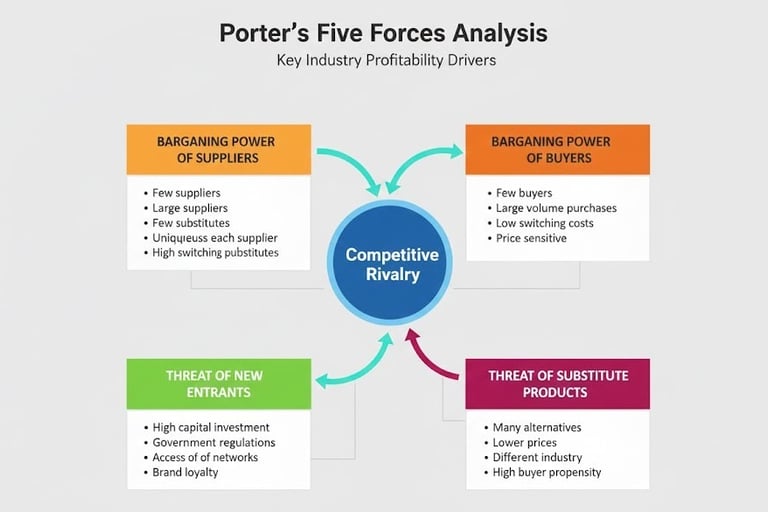
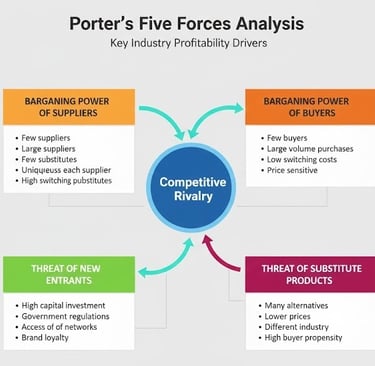
At the core of the model is competitive rivalry, surrounded by four other factors that collectively determine an industry's profitability.
Competitive Rivalry
This force examines the number and strength of competitors within an industry.
High Rivalry: When rivalry is intense, companies often lower prices and provide incentives to attract customers, which can reduce overall profitability.
Low Rivalry: Conversely, industries with less intense rivalry typically enjoy higher profit margins.
Bargaining Power of Suppliers
Suppliers can significantly influence an industry's profitability by affecting pricing. Suppliers have high bargaining power when:
There are few suppliers in the industry.
Customers are small or insignificant compared to suppliers.
There are few substitutes for the supplied goods or services.
The cost of switching suppliers is high.
Example (Automotive Industry): Companies like Bosch, Continental, or Michelin supply parts to car manufacturers. If these suppliers increase their prices, the cost of manufacturing cars rises.
Bargaining Power of Customers
Powerful customers can drive down prices, negatively impacting an industry's profits. Customers are powerful when:
There are few customers or customer groups.
Customers have many suppliers to choose from.
Switching costs are low for customers.
Certain customers purchase significant quantities of products or services.
Example (Automotive Industry): Car manufacturers (as customers of parts suppliers), dealerships, and particularly large rental and leasing companies can exert pressure on automotive companies.
Threat of Substitutes
Substitutes are alternative products or services from different industries that can fulfill the same customer need.
A higher number of substitutes typically drives prices down, affecting profits.
Conversely, a low number of substitutes can lead to a monopoly for an industry.
Examples: Choosing a budget airline instead of driving for inter-city travel can reduce demand for automotive vehicles. The rise of taxi services like Uber can sometimes be cheaper than owning and driving a personal vehicle, potentially affecting car sales in the long run. Additionally, solar energy companies pose a threat to traditional energy providers.
Threat of New Entrants
New companies entering a marketplace can reduce the market share and profitability of existing businesses. The threat is high if the barriers to entry are low. These barriers can include:
Required investment to start a company.
Government regulations.
Access to suppliers and distribution networks: Established companies often have better pricing and relationships with suppliers, which can be a barrier for new entrants.
Example (Automotive Industry): The emergence of electric car companies like Tesla has significantly impacted the automotive industry, forcing established manufacturers to develop their own electric vehicle lineups.

Porter’s Five Forces Video Tutorial
While valuable, the Porter’s Five Forces Model has certain limitations:
Industry-Specific Application: The model is designed for application at the industry level rather than for individual organizations. Many people incorrectly apply it to single companies, often using it alongside a SWOT analysis to gain a broader perspective.
Ignores Collaborations: The model does not consider collaborations or coalitions between buyers or suppliers, which can significantly influence pricing and market dynamics.
Focus on Profit-Oriented Industries: It is primarily tailored for understanding profit-driven industries and organizations, providing little insight for non-profit organizations or government entities.
Despite these limitations, the model offers a foundational understanding of industry attractiveness and competitive intensity, helping businesses strategize effectively within their chosen market.
Explore More Business Articles
Contact
Questions? Reach out anytime.
© 2025 BizSphere. All rights reserved.