
Analyzing Starbucks Through Porter’s Five Forces
by Divya Kolmi
12/18/20253 min read
Micheal E. Porter created the Five Forces model to assess the competitive dynamics within an industry. This straightforward yet powerful tool enables businesses to evaluate the intensity of competition and strategize accordingly. Porter identified five key forces that shape the competitive landscape. We will apply this model to analyze Starbucks as an example of Porter's Five Forces.
Starbucks is an American coffee and coffeehouse chain founded in 1971 by Jerry Baldwin, Zev Siegl, and Gordon Bowker. Renowned for its distinctive flavor and high-quality offerings, the company began with a single store and rapidly expanded through innovative business strategies and technology. Today, Starbucks boasts over 30,000 retail locations across 83 markets worldwide.
Starbucks and Porter's Five Forces
The coffeehouse industry is characterized by intense competition, significantly impacting business strategies and performance. Micheal E. Porter identified five key factors that influence this competitive landscape, particularly in relation to Starbucks:
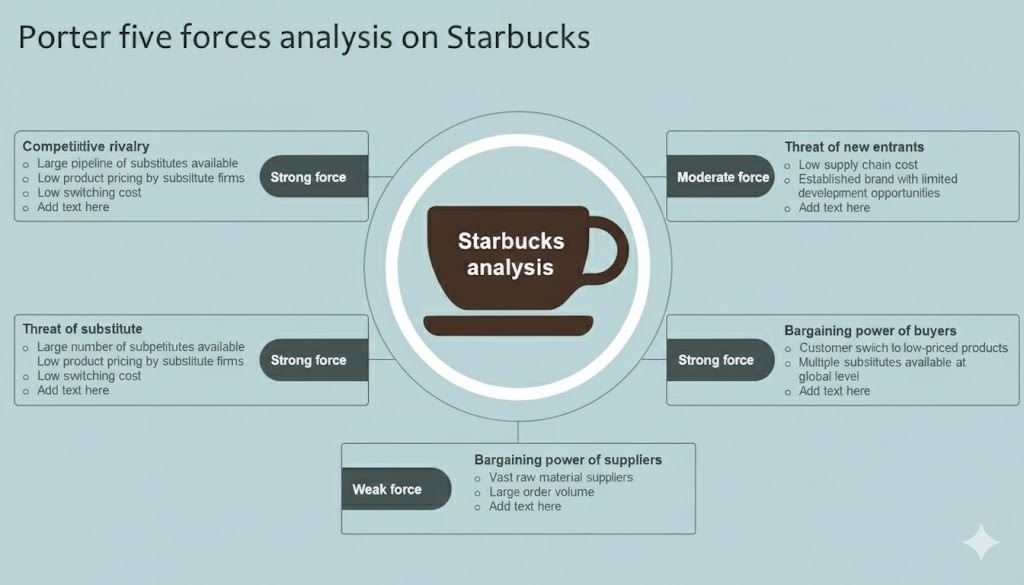
1. Competitive Rivalry (High)
Starbucks faces intense competition from global chains like Dunkin' and Costa Coffee, as well as local specialty cafes. Because there are no costs for a customer to switch from a Starbucks latte to a competitor's coffee, the brand must constantly innovate and invest in "The Third Place" experience to maintain loyalty.
2. Bargaining Power of Suppliers (Low to Moderate)
While coffee beans are a commodity, Starbucks requires high-quality Arabica beans. They mitigate supplier power by sourcing from thousands of individual farmers across Africa, Asia, and Latin America. Their C.A.F.E. Practices ensure ethical sourcing while preventing any single supplier from gaining too much leverage over pricing.
3. Bargaining Power of Customers (High)
Individual customers have significant power because they have endless choices. Whether it's a premium local roaster or a cheaper fast-food coffee, the low switching cost means Starbucks must use its rewards program and mobile app to "lock in" users and provide consistent value.
4. Threat of New Entrants (Moderate)
While it is easy to open a single coffee shop, it is incredibly difficult to replicate Starbucks' global scale, supply chain, and brand equity. The high capital required for international expansion and prime real estate acts as a barrier to new companies trying to compete at a global level.
5. Threat of Substitutes (High)
The threat isn't just other coffee shops; it’s anything that provides caffeine or a place to sit. Home-brewing kits (like Nespresso), energy drinks, bottled juices, and tea houses all serve as strong substitutes. Starbucks counters this by expanding its own "ready-to-drink" bottled products in grocery stores.
Strategies for Success
Analyzing Starbucks' current competitive position through Porter's Five Forces reveals several strategies for increasing market share and distinguishing itself from competitors. The key factors supporting this growth include:
Cost Leadership
Starbucks offers premium products, which results in higher prices compared to local brands. By introducing some lower-priced options, they could attract a broader customer base. Additionally, innovations in work practices and internal operations can help reduce costs. Exploring efficiencies in packaging, energy consumption, and logistics can also uncover opportunities for cost leadership. The example of Porter's Five Forces illustrates that Starbucks benefits from economies of scale, where large production volumes lead to lower costs per unit. Furthermore, their scale allows them to negotiate better prices from suppliers.
Differentiation
Starbucks can leverage a broad differentiation strategy for competitive advantage. The brand is already recognized for its high-quality coffee and unique flavors. This differentiation extends to the ambiance of their cafes, which provide a cozy and inviting atmosphere for customers. Expanding product offerings to include a variety of beverages beyond coffee can attract customers with diverse preferences. Additionally, entering the services and product sectors can further diversify Starbucks' portfolio.
Focus
As highlighted in the analysis of Porter's Five Forces, Starbucks emphasizes the premium quality of its coffee to draw in customers. They could also consider introducing more specialized products, such as ready-to-brew or ready-to-eat items for customers to enjoy at home. The focus strategy aims to increase market share by targeting a niche market with less competition, allowing Starbucks to operate effectively within this exclusive segment.
Starbucks is a premium coffee brand known for its commitment to ethical products and a responsible supply chain. Within Porter's Five Forces framework, several factors influence its business, with the most significant being competition, the threat of new entrants, and the bargaining power of buyers. Despite these challenges, Starbucks effectively navigates these forces through strategic analysis and product differentiation.
Explore More Business Articles
Contact
Questions? Reach out anytime.
© 2025 BizSphere. All rights reserved.