

Understanding the Computational Mindset: More Than Just Code
by Divya Kolmi
1/13/20262 min read
Programming is often misunderstood as a purely technical skill. In reality, it is a multidisciplinary way of thinking. To think like a computer scientist is to become a hybrid of three classical disciplines:
The Mathematician: Using formal languages to denote abstract ideas and computations.
The Engineer: Assembling components into systems and constantly evaluating the trade-offs between speed, cost, and reliability.
The Scientist: Observing complex systems, forming hypotheses about "bugs," and testing predictions through trial and error.
At its core, computer science is the art of 'Problem Solving': the ability to formulate a problem, think creatively about solutions, and express that solution with absolute clarity.
What is a Program?
A program is simply a sequence of instructions. Whether you are solving complex polynomials or processing high-definition video, every piece of software on earth is built from just five basic operations:
Input: Gathering data from the outside world (keyboard, sensors, or networks).
Output: Displaying or saving that data.
Math: Performing basic operations (addition, multiplication).
Conditional Execution: Making decisions (e.g., "If the user is logged in, show the dashboard; otherwise, show the login page").
Repetition: Performing actions repeatedly with slight variations.
2. The Language of Logic: Formal vs. Natural
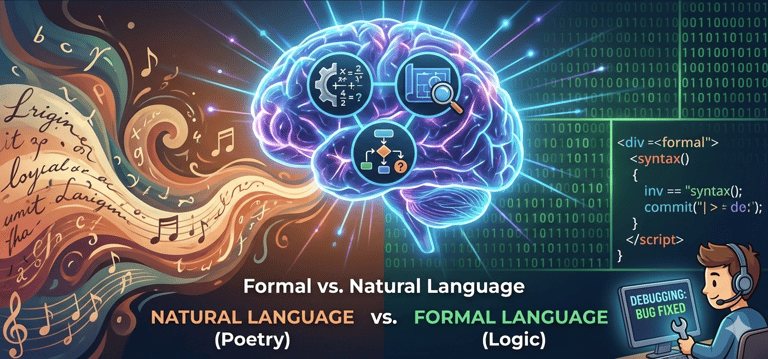
One of the hardest adjustments for new programmers is moving from Natural Language (English, Spanish) to Formal Language (Python, C++, Java).
The Ambiguity Gap
Natural languages evolved for human connection. They are beautiful because they are ambiguous and redundant. If I say, "The penny dropped," you know I mean "I finally understood," even though no physical currency was involved.
Formal languages, however, are literal. They have three distinct characteristics:
Unambiguous: Every statement has exactly one meaning, regardless of context.
Concise: They lack the "filler" and metaphors of human speech.
Strict Syntax: While you can understand a "broken" English sentence, a computer cannot "parse" a program if a single token (symbol) or structure is out of place.
The Analogy: If Natural Language is Poetry (where emotion and ambiguity are deliberate), then a Program is Technical Manual (where analysis and literalness are absolute).
3. Values, Types, and the Grammar of Code
In Python, we work with different "types" of data. Just as you wouldn't use a hammer to paint a wall, you don't use a "String" to perform "Integer" math.
Integers (2): Whole numbers for counting.
Floating-point (42.0): Numbers with decimals for precision.
Strings ('Hello'): Characters "strung" together for communication.
Understanding these types is the first step in avoiding Syntax Errors - the "grammar" mistakes of the digital world.
4. Debugging: Managing the "Heartless Employee"
Programming is the process of making mistakes and fixing them. This is called 'Debugging'. It can be an emotional rollercoaster - frustrating, humbling, and at times, exhausting.
The Strategy: Think of the computer as an employee with two specific traits:
Strength: Incredible speed and perfect precision.
Weakness: Zero empathy and a total inability to grasp the "big picture."
As a programmer, your job is to be a 'Good Manager'. You must give instructions that are so clear and so literal that even a heartless employee cannot misunderstand them. When a bug occurs, it isn't the computer "being difficult" - it is a manager giving an unclear directive.
The "Way of the Program" is a masterclass in precision. By learning to communicate with machines, we actually improve our ability to communicate with humans. We learn to strip away ambiguity, identify core logic, and manage complex systems with a scientific lens.
Welcome to the first step of the digital evolution.
Explore More Business Articles
Contact
Questions? Reach out anytime.
© 2025 BizSphere. All rights reserved.