

How Women in Business are Redefining Leadership
by Divya Kolmi
1/8/20263 min read
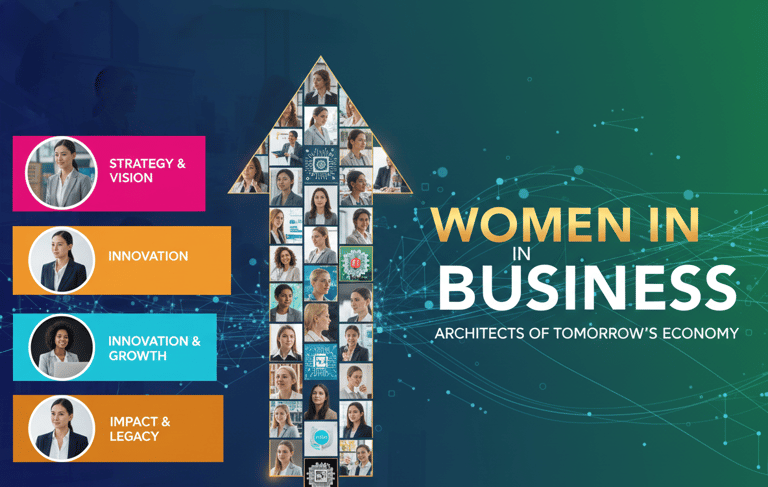
For decades, the conversation around women in business was focused on "breaking the glass ceiling." Today, the focus has shifted. It is no longer just about gaining entry into the boardroom; it is about how female entrepreneurs and executives are fundamentally rewriting the rules of engagement, risk, and innovation.
In my program, we explored how diversity isn't just a moral goal, it’s a "competitive necessity". When women lead, they bring a unique "Multiplier Effect" that impacts everything from employee retention to the bottom line.
Strategic Empathy as a Business Tool
One of the most significant shifts we see is the rise of "Strategic Empathy". This isn't just about being "nice"; it’s about understanding the deep needs of a customer base or a workforce to build more resilient products.
Example: Whitney Wolfe Herd (Founder of Bumble). She didn't just build another dating app; she identified a specific power imbalance in digital social dynamics. By giving women the "first move," she created a platform built on safety and accountability, a technological solution to a social problem that had been overlooked by male-dominated tech teams for years.
Resilience and Long-Term Thinking
Research consistently shows that women-led companies often prioritize long-term sustainability over short-term, high-risk gains. This approach acts as a natural form of Risk Assurance, creating companies that are better equipped to survive economic downturns.
Example: Sara Blakely (Founder of Spanx). Blakely’s story is a masterclass in intellectual persistence. She started with $5,000 in savings and maintained 100% ownership for years. Her journey highlights a distinct trend in female entrepreneurship: a focus on organic growth and "bootstrapping" that leads to massive, stable valuations without the need for reckless early-stage debt.
The Collaborative Ecosystem
Women in business are often at the forefront of the "Data Mesh" mindset, the idea that knowledge should be shared rather than hoarded. This collaborative leadership style reduces silos and increases the speed of innovation within an organization.
Example: Falguni Nayar (Founder of Nykaa). Nayar transitioned from a successful career in investment banking to launch India’s leading beauty retailer. Her success stems from her ability to bridge the gap between high-level finance and the granular, social-driven world of retail. She proved that technical expertise and market-specific intuition are most powerful when used together.
The intellectual evolution of business is being driven by women who refuse to simply "fit in" to existing structures. Instead, they are building new ones. For any student of business, the lesson is clear: the most successful organizations of the future will be those that value diverse perspectives not as a checkbox, but as the primary engine of their innovation.
The Funding Gap: A Trillion-Dollar Market Inefficiency
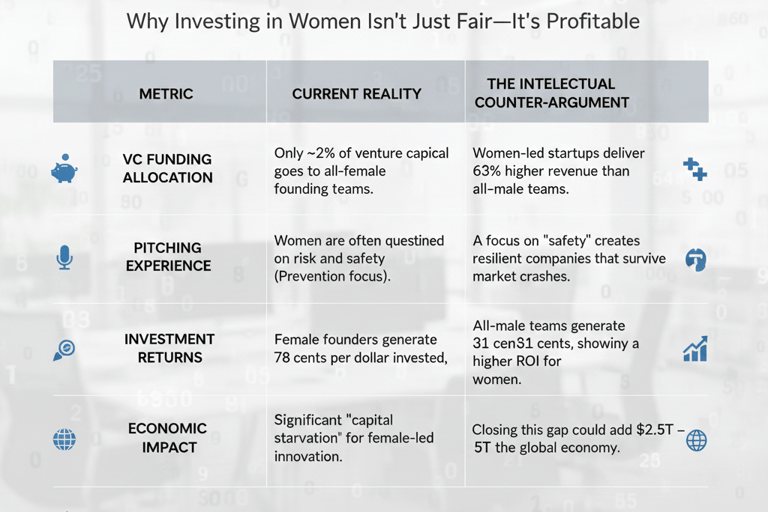
While the narrative around women in business is often one of "progress," the financial data reveals a stark "Intellectual Gap". Investors are currently leaving billions on the table by underfunding female founders. This isn't just about equity, it's about "Return on Investment (ROI)".
When we look at the numbers, we see a clear contradiction: women-led teams are receiving the least amount of capital while producing the highest comparative returns.
Key Takeaways
The "Prevention" Bias: During pitches, men are often asked how they will win (growth), while women are asked how they will not lose (risk). This bias in questioning directly leads to lower funding, despite the better performance metrics of female-led firms.
Superior Capital Efficiency: The "Investment Returns" metric is the most telling. Women are essentially doing more with less, proving they are more efficient at turning a single dollar of capital into revenue.
The Untapped Global GDP: The $5 trillion "Economic Impact" figure shows that the funding gap is a drag on the entire global economy, not just a specific sector.
The "Funding Gap" is an intellectual failure of the current venture capital model. For the next generation of leaders, the goal is to fix the systemic bias in how we evaluate potential. If we want a more resilient and profitable global economy, we must start funding the founders who have already proven they can deliver superior results with fewer resources.
Explore More Business Articles
Contact
Questions? Reach out anytime.
© 2025 BizSphere. All rights reserved.