

How Data Analytics Can Propel Your Business Growth
by Divya kolmi
12/18/20253 min read


Data holds immense potential for businesses, enabling them to gain insights into customer behavior, make predictions, and enhance advertising strategies. However, raw data alone is not immediately useful; it requires specific tools and methodologies for analysis to derive meaningful insights.
Understanding Customer Behavior Data
Customer behavior data is an invaluable asset, encompassing the actions users take while interacting with your products or services, or engaging with your content. Examples of these actions include making purchases, clicking on advertisements, commenting on posts, or liking content on social media. Analyzing this data can uncover customer preferences, as users may indicate their interests by exploring topics on your website or engaging with specific products through clicks on ads. This information can be instrumental in developing retargeting campaigns.
Data can manifest in various forms, such as survey responses, social media interactions, blog views, ad clicks, and demographic information. By merging behavioral data with demographic insights, businesses can effectively identify and define the customer segments they should target.
Key Analytics Applications in Business
The main types of analytics utilized in business include descriptive, diagnostic, predictive, and prescriptive analytics. The advantages of data analytics for businesses are numerous:
Informed Decision Making: Insights gained from data analytics empower businesses to make well-informed decisions, reducing reliance on guesswork. This leads to improved planning for marketing campaigns and more effective content creation and product development.
Enhanced Marketing Strategies: Data analytics provides critical insights into the performance of marketing campaigns, allowing for adjustments that yield better results. It also highlights audience engagement and the segments most likely to respond positively, resulting in more targeted marketing efforts that reduce waste and increase conversions.
Improved Customer Service: Data analysis can reveal customer preferences, interests, and concerns, enabling businesses to tailor their customer service approaches. This personalization fosters stronger relationships with customers by addressing their specific needs.
Operational Efficiency: By leveraging data analytics, companies can streamline their operations, reduce costs, and enhance profitability. A deeper understanding of customer desires minimizes time spent on ineffective ads and content, ultimately saving money while improving outcomes.
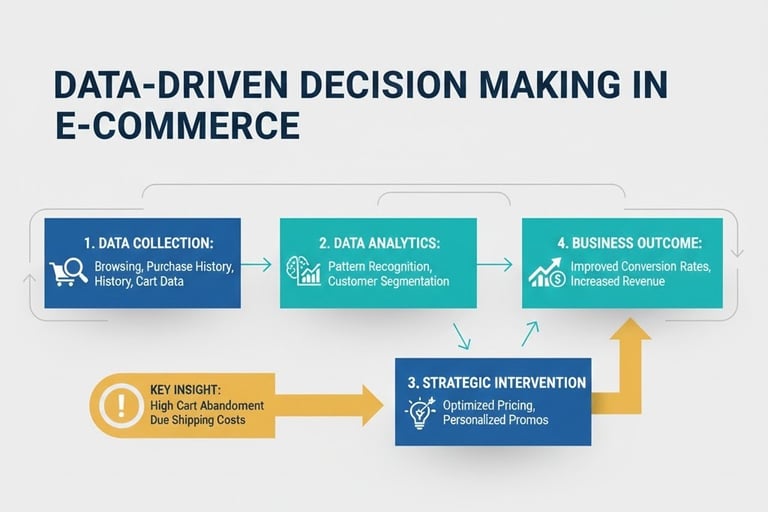
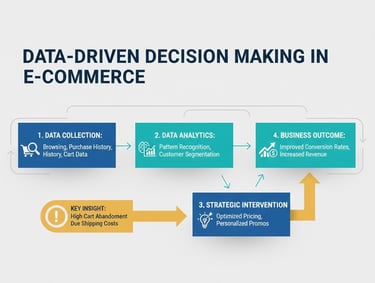
Data analytics plays a critical role in enabling organizations to make informed, evidence-based decisions that improve business performance. One illustrative example can be found in the e-commerce retail sector. An online apparel company may collect data on customer browsing behavior, purchase history, and cart abandonment rates. Through analytical techniques such as pattern recognition and customer segmentation, the firm may identify that a significant proportion of customers abandon their purchases due to shipping costs. By leveraging this insight, management can implement targeted interventions, such as optimized pricing strategies or personalized promotions, resulting in improved conversion rates and increased revenue.
The financial sector was among the earliest adopters of data analytics and continues to rely heavily on data-driven decision-making. Financial institutions use advanced analytical models to forecast market trends, evaluate credit risk, and support strategic investment decisions. Credit scoring systems, for example, integrate multiple data points, including repayment history, income stability, and debt levels, to assess borrower risk. Furthermore, data analytics is widely used in fraud detection, where real-time transaction monitoring helps institutions identify anomalous behavior, reduce financial losses, and enhance operational efficiency.
In the pharmaceutical industry, data analytics supports both strategic planning and research and development activities. Organizations analyze market and patient data to estimate demand, optimize product portfolios, and improve commercialization strategies. From a research perspective, the application of machine learning and predictive analytics enables firms to process complex biological datasets, accelerating drug discovery and increasing the likelihood of successful outcomes.
Overall, data analytics provides organizations with a sustainable competitive advantage by improving decision quality, reducing operational costs, and enhancing customer retention. As technological advancements continue to increase the availability and volume of data, the effective use of analytics has become a strategic necessity rather than a discretionary capability. Consequently, organizations that fail to integrate data analytics into their decision-making processes risk losing competitiveness in an increasingly data-driven business environment.
Explore More Business Articles
Contact
Questions? Reach out anytime.
© 2025 BizSphere. All rights reserved.