
November Inflation Cools to 2.7% Amid Data Delays
by Divya Kolmi
12/30/20252 min read
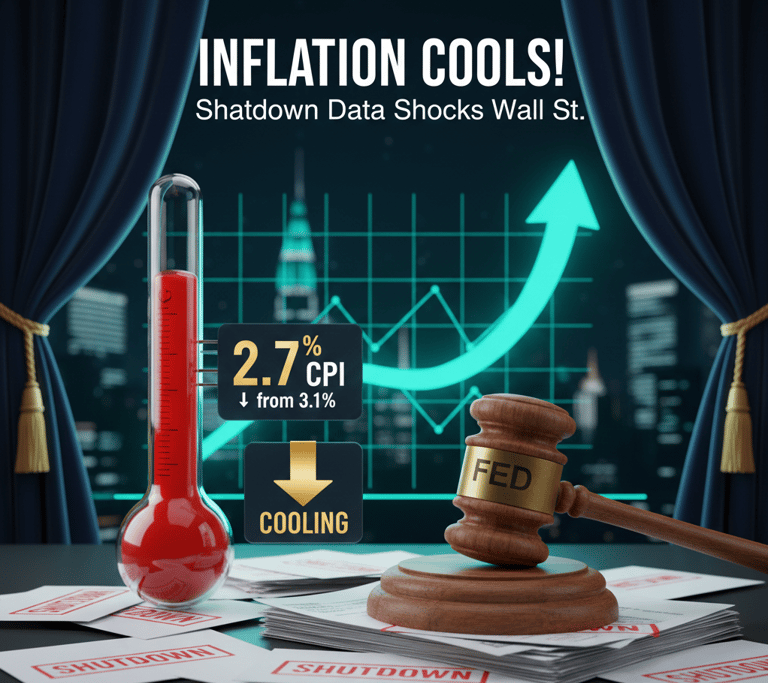
In a highly anticipated release that was pushed back by a government shutdown, the U.S. Bureau of Labor Statistics (BLS) finally pulled back the curtain on November’s inflation data. The verdict? Inflation is cooling faster than Wall Street anticipated.
While the data collection process was "messy" due to the recent federal stoppage, the numbers provide a significant sigh of relief for investors and a potential green light for the Federal Reserve to continue easing its monetary policy.
The Headliners: By the Numbers
The report shows a clear disconnect between what economists feared and what the data actually revealed:
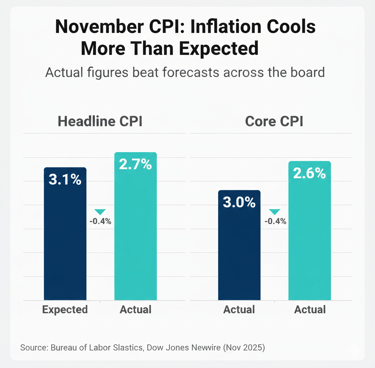
Annualized CPI: The Consumer Price Index rose at a 2.7% rate, significantly lower than the 3.1% consensus estimate from Dow Jones economists.
Core Inflation: Stripping out the volatile sectors of food and energy, the "Core CPI" came in at 2.6%, beating the 3.0% forecast.
Monthly Momentum: Both headline and core monthly gains sat at 0.2%, proving that price increases are stabilizing on a month-to-month basis.
The "Shutdown" Asterisk: Why this Data is Unique
This was not a standard data release. Because the U.S. government was shut down during the original data collection window, the BLS had to get creative.
Missing October Data: The October CPI report was cancelled entirely.
Proxy Sources: The BLS admitted they couldn't retroactively grab every data point, instead relying on “nonsurvey data sources” to finalize the index.
Economist Skepticism: Some analysts warn against calling this a "permanent trend" just yet, as the gap in October’s data makes the year-over-year comparison slightly less precise than usual.
Victory in the "Shelter" Sector
For over a year, Shelter costs, which represent roughly one-third of the total CPI weight, have been the biggest hurdle for the Federal Reserve. This report showed shelter costs rising at just 3%, a major move toward the Fed’s ultimate target of 2% overall inflation.
While energy prices saw a slight 4.2% bump and food rose 2.6%, the cooling in housing is the "sticky" metric that the Fed has been waiting for.
The Pivot: What This Means for Interest Rates
The market reaction was instantaneous. As the news broke, Treasury yields slipped (with the 10-year note trading at 4.11%), and S&P 500 futures jumped 0.5%.
The "Fed Put" is Back: Tom Lee of Fundstrat noted that a "tame CPI" reinforces the idea that the Fed is shifting its focus from fighting inflation to protecting the labor market. In trader speak, this creates a "Fed Put", the belief that the Fed will intervene with rate cuts if the economy shows any signs of a downturn.
March 2026 Forecast: While a January rate cut remains unlikely, the probability of a March 2026 reduction has climbed to 58.3%, up from 53.9% just a day ago.
This report suggests that the U.S. economy is successfully threading the needle. We are seeing lower inflation without a massive spike in unemployment. However, with the "statistical noise" caused by the government shutdown, the January 2026 report will be the true test of whether this cooling is here to stay.
Explore More Business Articles
Contact
Questions? Reach out anytime.
© 2025 BizSphere. All rights reserved.