Red Bull’s Media Empire: How to Sell a Product by Never Marketing It
by Divya
3/17/20264 min read


Walk into any supermarket, and you will see the iconic blue-and-silver slim cans of Red Bull. By traditional business metrics, Red Bull is one of the most successful consumer packaged goods (CPG) companies in history.
But if you look closely at how the company allocates its multi-billion-dollar budget, you will find something shocking: Red Bull is not a beverage company. It is a high-octane media conglomerate that happens to sell energy drinks.
While competitors like Monster or Rockstar spend millions of dollars buying traditional television commercials or billboard ads telling you how good their drinks taste, Red Bull takes a completely different path. They buy professional sports teams, produce television documentaries, host global music academies, and fund record-breaking stunts.
This case study breaks down Red Bull’s revolutionary Content Marketing Ecosystem and explains how to build massive brand equity by selling a lifestyle instead of a product.
1. The Core Marketing Framework: The Brand as a Publisher
Traditional marketing relies on interruption. A consumer wants to watch a football game, and the brand interrupts them with a 30-second commercial.
Red Bull rejects this model completely. Instead of interrupting the entertainment, Red Bull becomes the entertainment. They operate through their internal subsidiary, Red Bull Media House, a fully functional, independent multi-platform media company.
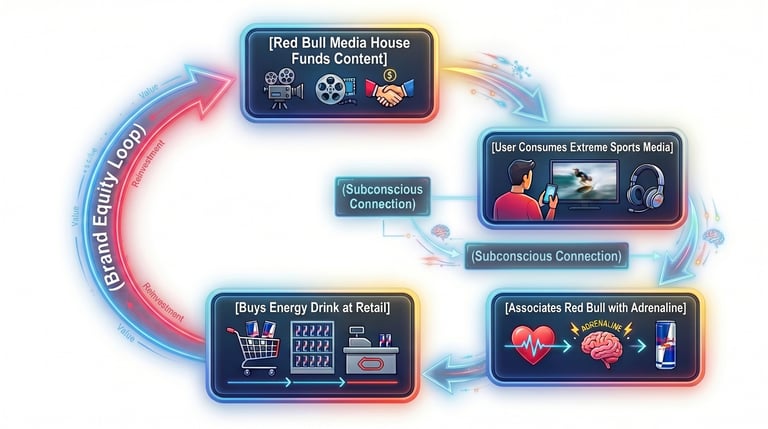
By producing high-quality movies, magazines, and live sports broadcasts, Red Bull creates assets that consumers actively seek out. The energy drink itself steps into the background, functioning as a silent sponsor of a cultural movement.
2. Strategic Execution: Lifestyle Association & The Extreme Sports Monopolization
To understand how deeply embedded Red Bull is in modern culture, look at their ownership portfolio. They do not just put their logo on a stadium wall; they buy the entire stadium.
The Red Bull Asset Portfolio
Formula 1 Racing: Owners of Oracle Red Bull Racing and Visa Cash App RB, capturing hundreds of millions of global viewers every single weekend.
Global Football (Soccer): Ownership of major clubs including RB Leipzig (Germany), New York Red Bulls (USA), and FC Red Bull Salzburg (Austria).
Extreme Sports Events: Creators of proprietary, boundary-pushing competitions like Red Bull Rampage (freeride mountain biking) and Red Bull Cliff Diving.
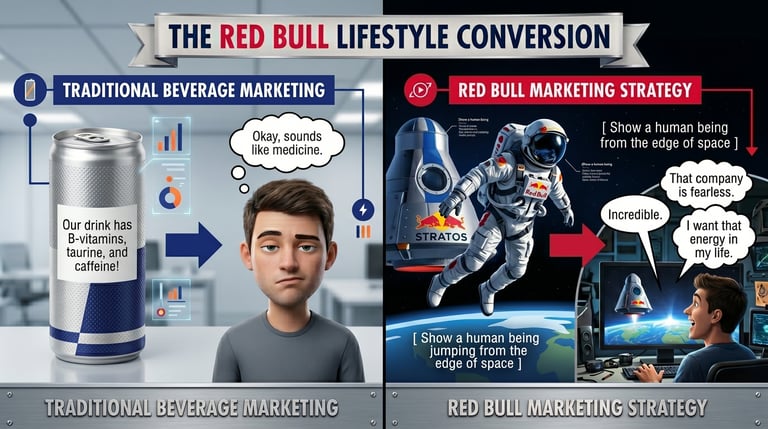
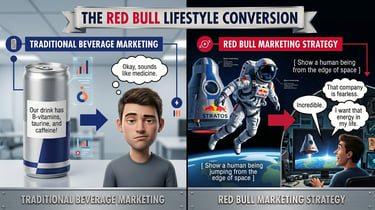
When a consumer buys a can of Red Bull, they are not buying a chemical recipe of sugar and caffeine. They are buying a piece of an identity rooted in adrenaline, peak human performance, and boundary-pushing adventure.
3. Case in Point: Visualizing Marketing ROI (The Stratos Shift)
The ultimate validation of Red Bull’s media-first strategy came in 2012 with Red Bull Stratos. Austrian skydiver Felix Baumgartner ascended into the stratosphere in a helium balloon and jumped from a record-breaking altitude of 128,000 feet, breaking the sound barrier in freefall.
To truly appreciate the genius of this stunt, look at how it completely broke traditional marketing ROI (Return on Investment) metrics. While typical ad spend scales linearly with view counts, Red Bull created an exponential "Earned Media" phenomenon.
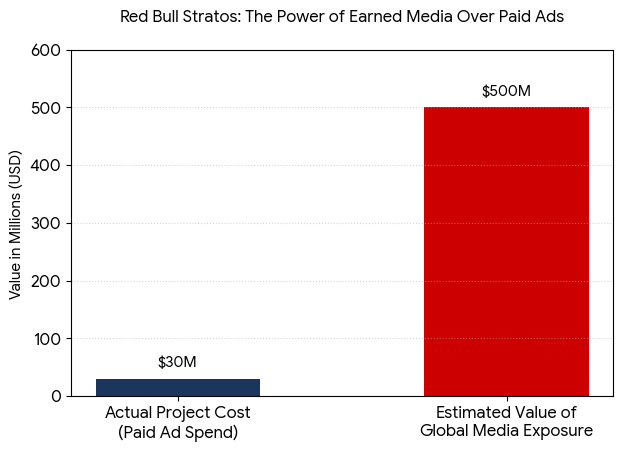
Instead of buying $30 million worth of fleeting, unmemorable banner ads, Red Bull created a permanent historical event that generated over $500 million in earned media value, cementing their slogan,"Red Bull Gives You Wings", into human history.
4. The Financial Engine: Flipping the Cost Center
In a normal corporate structure, marketing is a pure cost center, money goes out, and hopefully, sales revenue comes in. Red Bull Media House flips this dynamic on its head.
Because their content is so compelling, Red Bull is able to monetize their marketing materials directly:
They license their extreme sports footage to other major networks.
They sell commercial ad space during their live broadcasts.
They sell physical merchandise and event tickets directly to fans.
This creates a highly efficient corporate loop: the marketing machine generates its own revenue, which reduces the net cost of acquiring new customers for the beverage side of the business.
Key Takeaways for Businesses
Stop Selling Features, Sell Values: Consumers do not fall in love with product specifications; they fall in love with what your product allows them to become.
Invest in Owned Assets: Relying entirely on paid advertising channels (like Google or Meta ads) leaves you vulnerable to rising ad prices. Building your own audience media channel creates permanent, long-term brand equity.
Be Your Audience's Biggest Fan: Find the specific subculture or lifestyle that uses your product, and fund the things they love. If your audience loves design, fund design documentaries. If they love tech, host hackathons.
Explore More Business Articles
Contact
Questions? Reach out anytime.
© 2025 BizSphere. All rights reserved.