
How Uber Uses Surge Pricing to Clear the Market
by Divya
3/16/20263 min read
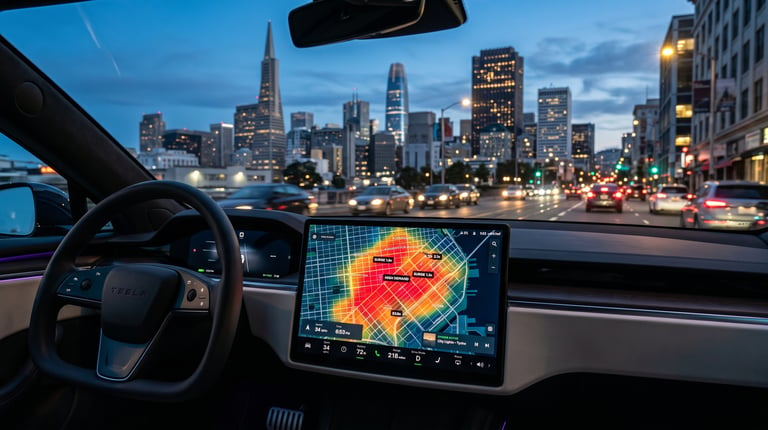

Imagine it is Friday night at 5:00 PM. A sudden, torrential downpour hits the city center. Simultaneously, thousands of commuters pour out of office buildings, pull out their smartphones, and open the Uber app.
Under a traditional fixed-tariff taxi system, this massive demand spike creates an immediate shortage. Phone lines jam, physical queues grow infinitely long, and passengers wait hours for a ride.
But Uber operates differently. Within minutes, a lightning bolt symbol appears on user screens: Surge Pricing is active. Prices double, triple, or quadruple.
While frustrating for consumers, this is a masterclass in modern microeconomics. This case study explores how Uber turns an algorithmic data loop into a real-time market clearing mechanism.
1. The Core Economic Framework: Dynamic Equilibrium
In textbook economics, markets naturally move toward an equilibrium price, the exact point where the quantity demanded by consumers matches the quantity supplied by producers.
In the physical world, changing prices takes time. Restaurants must reprint menus, and retail stores must update price tags. Uber eliminates this friction completely. Its algorithmic engine recalculates prices minute-by-minute for localized zones using a closed-loop system:
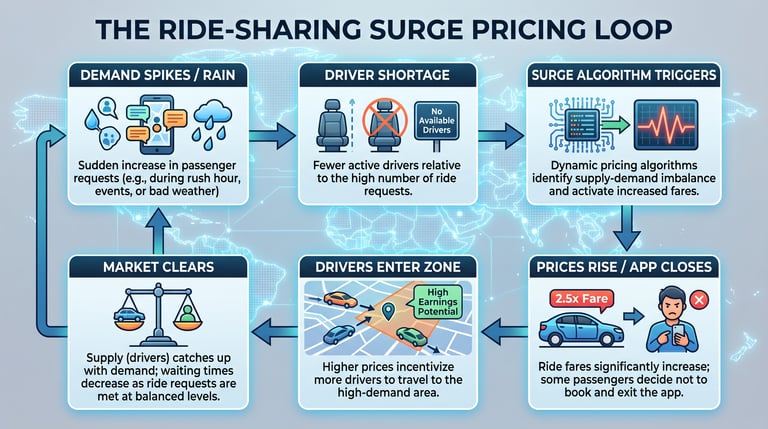
When a demand shock occurs, the algorithm artificially creates a new, temporary equilibrium price. This high price performs two vital economic functions simultaneously:
The Rationing Function (Demand Side): It filters out low-utility passengers. Commuters unwilling to pay $40 for a short trip opt for public transit or wait out the storm in a coffee shop.
The Allocative Function (Supply Side): It acts as an economic incentive. Off-duty drivers at home see the high surge rates on their heat maps and choose to log on and start driving.
2. Visualizing the Shock: The Supply and Demand Graph
To see exactly how this mathematical model functions on a graph, we can map the shift in real-time equilibrium. When an unexpected event hits, the entire demand curve shifts violently to the right, driving up the market clearing price.
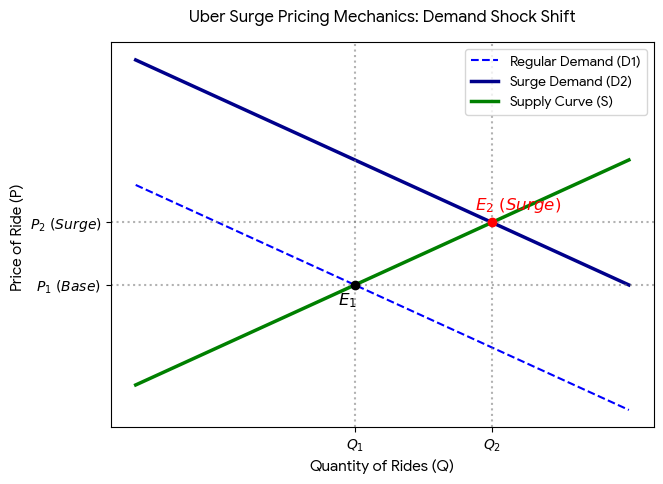
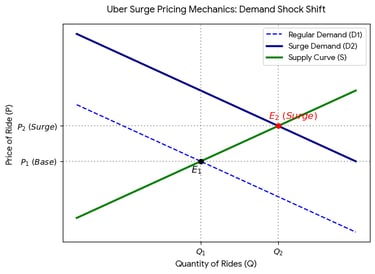
As shown in the visualization, the shift from D1 to D2 instantly creates a shortage at the base fair (\(P_{1}\)). By automatically adjusting to \(P_{2}\), Uber ensures that the quantity of riders matches available drivers, allowing rides to remain continuously accessible for those who need them most.
3. The Role of Price Elasticity
The success of dynamic pricing relies entirely on Price Elasticity of Demand (PED), how sensitive consumers are to a change in price.
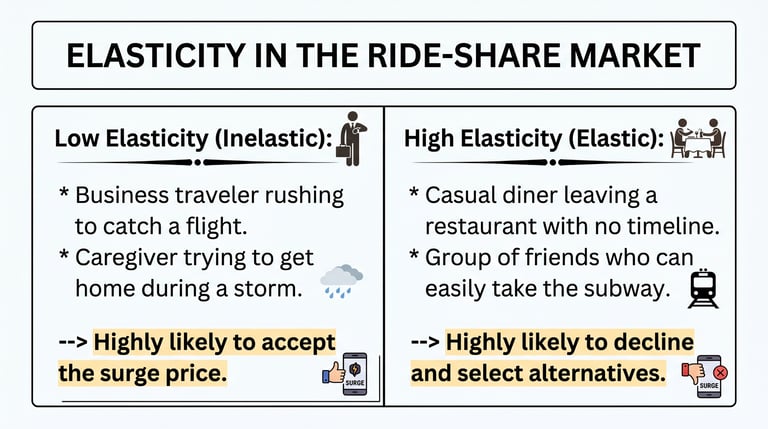
Uber’s algorithm doesn't know why you need a ride, but its pricing structure forces you to self-select based on your personal elasticity. This maximizes total market efficiency, routing vehicles strictly to high-utility trips.
4. The Ethics of the Algorithm: Fairness vs. Efficiency
While perfectly logical on paper, surge pricing creates a massive friction point regarding consumer psychology. It highlights a classic tension in economic policy: Allocative Efficiency vs. Social Equity.
The Case for Efficiency: Proponents argue that surge pricing prevents systemic market failure. Without it, the app would show "No Cars Available," rendering the service useless for everyone. It allocates a scarce resource to those who value it most financially.
The Case for Equity: Critics point out that "willingness to pay" is tied directly to "ability to pay." During extreme events—like severe transit strikes or blizzards—surge pricing can resemble price gouging, trapping low-income commuters while letting affluent users bypass the emergency effortlessly.
The Strategic Pivot
To manage public backlash, companies like Uber now cap extreme surges during declared natural disasters or states of emergency. They have also experimented with Upfront Pricing, showing a flat dollar amount rather than an explicit "2.5x multiplier." This reduces the psychological sticker shock while keeping the underlying market clearing algorithm fully intact.
Key Takeaways for Businesses
Static Pricing is a Liability: If your demand fluctuates wildly but your prices remain rigid, you are regularly leaving money on the table or creating artificial shortages.
Use Price to Control Capacity: You can use variable pricing structures to smooth out operational bottlenecks and manage limited labor resources.
Manage the Customer Psychology: Algorithms don't care about human feelings, but customers do. Transparency and predictable guardrails are necessary to protect brand equity from being labeled unfair.
Contact
Questions? Reach out anytime.
© 2025 BizSphere. All rights reserved.