
My Take: Hyphen’s Robots are Coming for Your Burrito Bowl – And That's Both Exciting and Concerning
by Divya kolmi
1/1/20263 min read
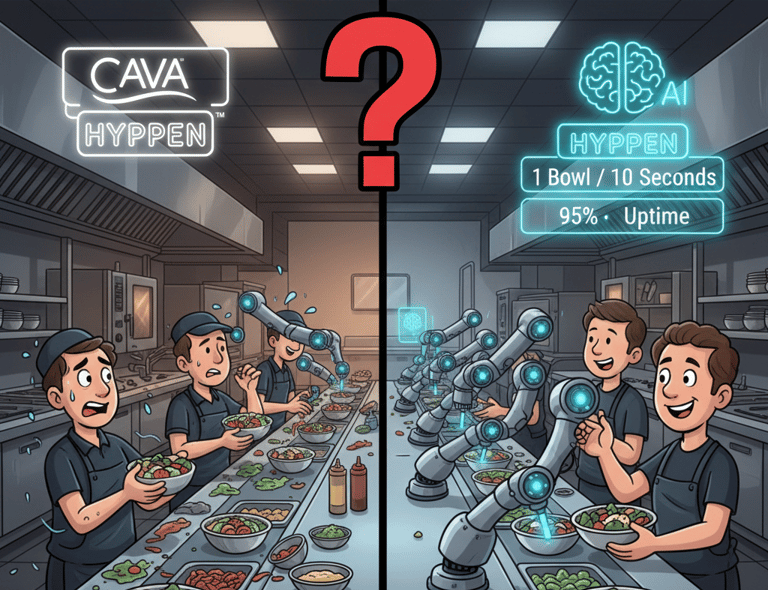
The news that Hyphen, with serious backing from Chipotle and Cava, is rolling out automated makelines in the fast-casual space is, to me, one of the most significant developments in the restaurant industry this year. On one hand, it’s a brilliant solution to persistent problems. On the other, it raises some serious questions about the future of work in a sector that employs millions.
Let’s be honest, anyone who’s ever stood in a Chipotle line during the lunch rush knows the pain. Orders stacking up, harried employees, and the occasional feeling that your carefully customized bowl is being haphazardly thrown together. This is where Hyphen steps in, promising a "bowl every 10-15 seconds", perfect portioning, and less food waste. From a business perspective, it’s a no-brainer. Cost savings, increased throughput, happier customers (theoretically) – what's not to love?
The Business Case is Undeniable
For chains like Chipotle and Cava, who’ve seen their stock prices dip amidst shifting consumer habits, this is a lifeline. Investing in automation is a move towards sustainability in a hyper-competitive market. The ROI, at less than a year for a $50k-$100k unit, makes it an incredibly attractive proposition. This isn't just about cutting costs; it's about optimizing the entire operational flow, especially for the booming digital and takeout order segments that demand speed without sacrificing accuracy.
I particularly appreciate the focus on reducing food waste – tracking ingredients "down to the gram" is not just efficient, it's environmentally responsible. In an industry notorious for waste, this is a significant step forward.
But What About the Human Element?
Here’s where my opinion gets a little more complex. Hyphen's CEO, Stephen Klein, talks about creating a "less chaotic and more elegant experience" for workers, allowing them to focus on "selling ingredients on top" while robots do the repetitive prep underneath.
My question is: how many workers will be left to have this "elegant experience"?
While the narrative is always about enabling employees to do "higher-value tasks," the reality is often a reduction in overall headcount. Fast-casual jobs, particularly on the makeline, are often entry-level positions that provide crucial income and experience for many. If a robot can make 4-6 bowls a minute with perfect precision, how many human hands will truly be needed to "jump in" during the "rare moments" of downtime, or simply to add a final garnish?
This isn't to say innovation is bad, but we must acknowledge the disruptive impact. The restaurant industry is a massive employer. As automation becomes more sophisticated and cost-effective, the conversation needs to shift from "if" these jobs will be impacted to "how" we prepare the workforce for this transformation.
The Future of Dining: Efficiency Over Everything?
This move by Hyphen, Chipotle, and Cava signals a clear trend: the future of fast-casual dining will be increasingly defined by efficiency and precision. The days of purely human-powered, assembly-line food prep might be numbered for high-volume, customizable concepts.
While this might lead to faster, more consistent food for consumers, I also wonder if it risks diminishing the "human touch" that some diners still value. Is the efficiency gain worth the potential trade-off in human interaction, even if brief?
My Conclusion
Ultimately, Hyphen's technology is a powerful solution to real industry problems. It's smart, it's efficient, and it's backed by major players for a reason. But as we embrace this technological leap, we must do so with our eyes wide open to its broader implications. We need to celebrate the innovation while simultaneously asking hard questions about its impact on the workforce and the evolving nature of our dining experiences.
Contact
Questions? Reach out anytime.
© 2025 BizSphere. All rights reserved.