

I Cannot Support Starbucks When Their $38.9 Million Fine Proves Their 'Partner' Label is a Lie.
by Divya Kolmi
12/12/20252 min read
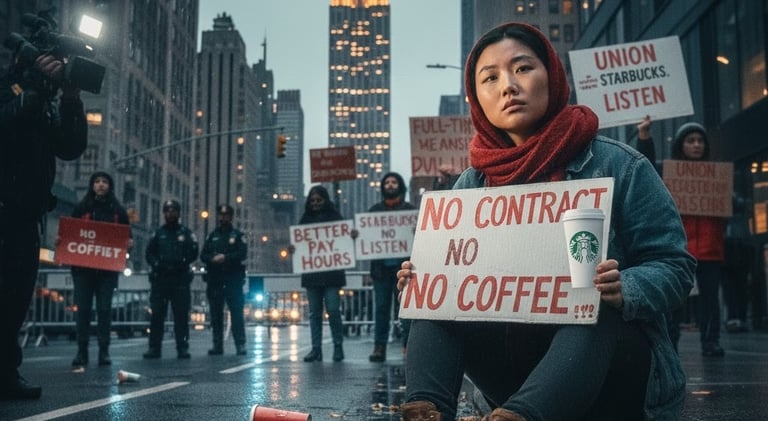
I have been watching the Starbucks Workers United strike escalate, and the spectacle outside the Empire State Building on December 4th really hit home. It’s not about coffee; it’s about a painful contradiction in the modern workplace that I, and frankly, every customer, need to acknowledge.
Starbucks calls its employees "partners," suggesting a shared vision and mutual respect. Yet, as I see pictures of baristas, mostly young people working two jobs, trying to afford rent, or attending school, being arrested for demanding basic stability, that word "partner" sounds like a cruel joke.
The Personal Cost of a Broken System
For me, the issue boils down to the workers' main demands: predictable hours and a living wage.
We, as consumers, rarely think about the human cost behind that flawless mobile order. But consider what it means to be a barista trying to budget:
The Hour Cut: Union delegates report that the company often keeps baristas just under the 20-hour-per-week threshold needed to qualify for certain benefits. This isn't just an HR policy; it’s a direct financial threat to a worker’s ability to secure healthcare or tuition assistance, benefits Starbucks famously promotes. It’s a deliberate strategy that keeps people desperate for hours, robbing them of stability.
The Fair Workweek Scandal: The $38.9 million settlement in New York City is the biggest admission of guilt. It means that for years, thousands of baristas couldn't plan their lives. I can only imagine the personal chaos: cancelling childcare, missing a college class, or turning down a second job because their schedule was erratic or illegally changed without notice. As one former employee said, you see co-workers who are in "physical pain" because they're constantly on their feet, juggling multiple jobs.
When Starbucks complains that the scheduling laws are "notoriously challenging," I hear a massive corporation saying, "It's too much effort to treat our 'partners' like human beings with lives outside this store."
My Line in the Sand: The Red Cup Rebellion
Starbucks is trying to spin this as a negligible disruption, touting their record-breaking Red Cup Day. They believe that their marketing machine and convenience will trump the moral argument.
But the union is winning the moral argument. Every time the CEO's $95 million-plus compensation is mentioned alongside the baristas' $15-an-hour wage, the hypocrisy is blinding. The company has the resources to settle a massive fine and invest $500 million in better tech, but they won't agree to a contract that gives workers guaranteed protection.
For me, the decision is simple: I can not in good conscience support a company that has systematically broken the law to deny its frontline workers stability. Until United Workers has a legally binding contract—a sign that their voice and their lives are truly valued, I will honor the picket lines.
This fight isn't just about coffee. It's about whether American corporations will ever treat the people who generate their billions with dignity. And right now, my money is staying out of the register.
Explore More Business Articles
Contact
Questions? Reach out anytime.
© 2025 BizSphere. All rights reserved.