

Iteration and Variable : Understanding How Programs Evolve Over Time
by Divya Kolmi
1/29/20264 min read
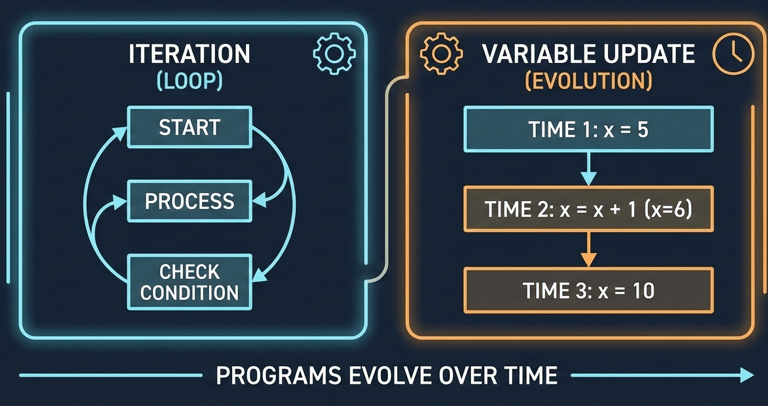
In programming, variables are not static containers. Very often, a variable’s value changes as a program runs. This pattern is known as updating a variable, where the new value depends on what the variable already holds.
For example:
x = x + 1
This line tells the program to take the current value of x, increase it by one, and then store the result back into x. The old value is replaced by the new one.
However, Python cannot update a variable that has never been created. If you try to use a variable before assigning it an initial value, the program will stop with an error. That’s why variables must be initialized first:
x = 0
x = x + 1
Increasing a value by one is called an increment, while decreasing it by one is known as a decrement. These operations are extremely common in counting, tracking progress, and measuring totals.
Repetition in Programs: The Role of Loops
Many real-world tasks involve repetition - checking inventory, processing transactions, or counting user actions. Computers excel at repeating tasks accurately, which is why programming languages provide tools for iteration.
One of the most basic looping structures in Python is the while loop. It allows a program to repeat a block of code as long as a condition remains true.
n = 5
while n > 0:
print(n)
n = n - 1
print("Blastoff!")
This program starts with a number and counts downward until it reaches zero. Each time the loop runs, the value of n changes, moving the program closer to completion.
How a While Loop Actually Works
A while loop follows a predictable cycle. First, Python checks the condition. If the condition evaluates to false, the loop stops. If it is true, the loop body runs, and then Python checks the condition again.
Each pass through the loop is called an iteration. In the countdown example, the loop runs five times, once for each value of n.
To ensure that a loop eventually ends, something inside the loop must change. The variable responsible for controlling this behavior is known as the iteration variable. If no such variable exists, the loop may never terminate.
Infinite Loops and Why They Happen
An infinite loop occurs when the condition for stopping is never met. A humorous real-world example is the instruction “repeat” without specifying when to stop.
In programming, this often happens when the loop condition is always true:
while True:
print("Running forever")
This loop has no built-in exit and will continue until the program is forcibly stopped. While this may seem useless, intentional infinite loops can be helpful when paired with a controlled exit mechanism.
Exiting Loops Using break
Sometimes, you only know when to stop looping from inside the loop itself. In such cases, Python allows you to exit immediately using the break statement.
while True:
user_input = input("> ")
if user_input == "done":
break
print(user_input)
print("Done!")
Here, the loop continues indefinitely until the user types a specific word. This approach allows flexibility and makes the stopping condition easier to express.
Skipping an Iteration with continue
There are situations where you want to ignore certain inputs but continue looping. The continue statement skips the rest of the current iteration and moves back to the top of the loop.
while True:
line = input("> ")
if line.startswith("#"):
continue
if line == "done":
break
print(line)
print("Done!")
In this example, lines beginning with a special character are ignored, while other inputs are processed normally.
Definite Loops with for
When the number of repetitions is known in advance, Python provides the for loop. Unlike a while loop, which depends on a condition, a for loop processes a predefined collection of items.
friends = ["Joseph", "Glenn", "Sally"]
for friend in friends:
print("Happy New Year:", friend)
The loop runs once for each element in the list. The variable friend takes on a new value during each iteration, moving through the collection until all items have been processed.
Common Loop Patterns in Practice
Loops are often used to analyze data sets, such as lists of numbers. Many patterns follow a similar structure: initialize variables, process items one by one, and examine results after the loop finishes.
To count how many values appear in a list:
count = 0
for number in [3, 41, 12, 9, 74, 15]:
count = count + 1
print(count)
To calculate the total of all values:
total = 0
for number in [3, 41, 12, 9, 74, 15]:
total = total + number
print(total)
In these examples, count and total are accumulators, meaning they store results that grow over time.
Finding Maximum and Minimum Values
Another common task is identifying the largest or smallest value in a sequence.
largest = None
for number in [3, 41, 12, 9, 74, 15]:
if largest is None or number > largest:
largest = number
print(largest)
The variable largest represents the best value found so far. It starts as None and updates only when a larger value appears.
The same logic applies when finding the smallest value, using a less-than comparison instead.
Debugging with a Strategic Approach
As programs grow, errors become harder to locate. Instead of checking code line by line, an effective strategy is debugging by bisection.
This method involves inserting checks at strategic points in the program to narrow down where things go wrong. If the output is incorrect at a midpoint, the problem lies earlier. If it’s correct, the issue must be later.By repeatedly narrowing the search space, you can locate bugs far more efficiently than scanning every line.
Iteration is more than a programming technique - it reflects how systems think, adjust, and improve over time. Whether counting transactions, processing user input, or scanning performance metrics, loops turn static instructions into dynamic processes.
Explore More Business Articles
Contact
Questions? Reach out anytime.
© 2025 BizSphere. All rights reserved.