
How Netflix is Winning the 'Hybrid' Streaming War
by Divya Kolmi
1/21/20262 min read
For years, Netflix was the lone holdout of the subscription-only dream. "No ads, ever" was practically a company mantra. Fast forward to early 2026, and the narrative has shifted entirely. Netflix isn't just an ad-supported platform; it's becoming an advertising powerhouse.
The Q4 2025 earnings report reveals a company that has successfully navigated the transition from a "growth-at-all-costs" startup to a diversified, profitable media titan.
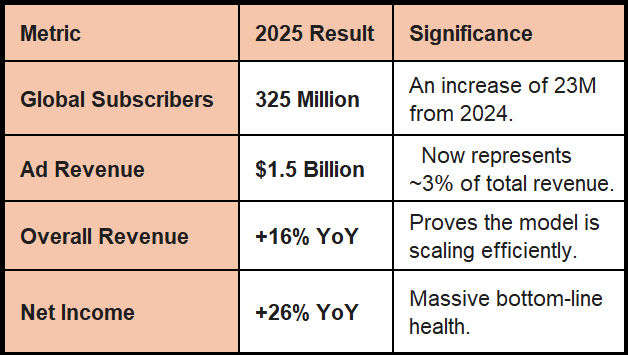
The 2025 Performance Scorecard
Despite Wall Street’s slight hesitation over forecasted figures, the actual growth metrics for 2025 are formidable:
Why the "Late Move" was the Right Move
While critics pointed out that Netflix joined the ad game later than Hulu or Disney+, the analysis suggests this was a calculated strategic move.
1. Netflix didn't just launch an ad tier; they combined it with the most aggressive password-sharing crackdown in history. This was a masterclass in consumer psychology. By removing "free" access, they gave users two choices: pay full price for a standard sub or "save money" with the ad tier. Many chose the latter, creating a massive, instant audience for advertisers that didn't exist two years ago.
2. Co-CEO Greg Peters noted that the gap between what Netflix makes on a standard subscriber versus an ad-supported subscriber is narrowing. The Insight: In the long run, ad-supported users may actually be more profitable than standard users. If a user watches enough content, the "CPM" (cost per thousand views) earned from advertisers can easily exceed the $7.00–$10.00 difference between subscription tiers.
3. The news that Netflix is eyeing Warner Bros. Discovery’s assets (HBO, CNN, DC Universe) changes the game. To keep ad revenue growing, you need "appointment viewing" and massive libraries. Acquiring WBD would give Netflix the premium IP required to command top-tier advertising rates, rivaling traditional broadcast TV during events like the Super Bowl or the Olympics.
In our previous post, we discussed the supply chain layoffs triggered by tariffs. Interestingly, Netflix’s success is the "flip side" of that economic coin. As businesses (the "Buyers" in our Porter’s Five Forces lesson) face rising supply chain costs, they are becoming more selective with their marketing spend. They are moving money away from broad "shotgun" TV ads and into the highly targeted, data-rich ecosystem that Netflix provides.
Netflix’s $1.5 billion ad revenue is likely being "cannibalized" from traditional TV networks that can't offer the same level of user data.
Takeaway
Netflix is no longer a "tech company that streams movies." It is a global advertising platform that happens to produce the world’s most-watched content. By successfully narrowing the revenue gap between its tiers, it has created a "Profit Stronghold" that is incredibly difficult for competitors like Disney+ or Paramount to breach.
The ad business is expected to double in 2026. If it does, Netflix won't just be leading the streaming war, they will have ended it.
Contact
Questions? Reach out anytime.
© 2025 BizSphere. All rights reserved.