

Functions: Turning Repetition Into Reasoning
by Divya Kolmi
1/27/20263 min read
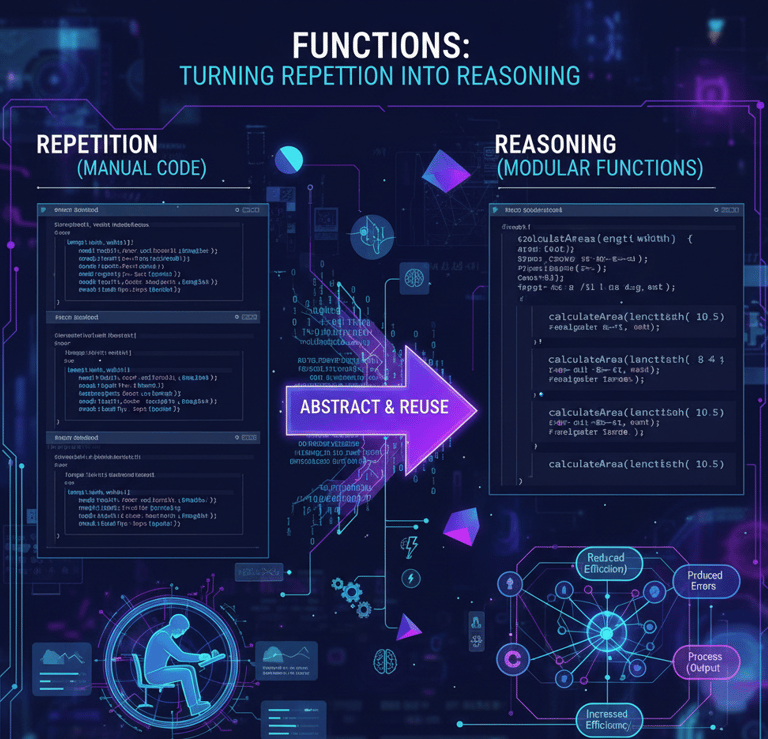
As programs grow beyond a few lines, the question shifts from “Can this run?” to “Can this scale, adapt, and be understood?” Functions are the answer to that question. In programming, a function is a named sequence of statements that performs a specific task. Conceptually, functions allow us to bundle logic, give it meaning, and reuse it, much like standardized processes in business or reusable models in analytics.
At the simplest level, a function is defined once and called whenever needed. When we call a function, we pass inputs called arguments, and the function may return a result. For example, when Python evaluates the type of a value, it uses a built-in function that takes an argument and returns information about it.
type(42)
Here, type is the function name, 42 is the argument, and the output is the return value. This pattern - input, transformation, output - is foundational. It mirrors how analytical tools process data or how business rules transform inputs into outcomes.
Many built-in functions exist to convert data from one form to another, reinforcing the idea that functions act as translators between representations. The int, float, and str functions convert values across data types, succeeding only when the conversion makes logical sense.
int('32')
float('3.14159')
str(32)
These conversions resemble data-cleaning steps in analytics, where raw inputs must be standardized before meaningful analysis can occur. When a conversion fails, Python raises an error, signaling that the assumption behind the transformation was invalid.
Functions become even more powerful when combined with modules. A module is simply a collection of related functions, grouped for clarity and reuse. Python’s math module, for example, provides access to well-known mathematical operations that would be inefficient to reimplement manually.
import math
math.sqrt(2)
This modular structure reflects how organizations rely on specialized toolkits: finance libraries, forecasting frameworks, or risk models - to avoid reinventing proven logic.
One of the most important ideas related to functions is composition. Functions can take not only simple values as arguments, but entire expressions or even other function calls. This allows complex logic to be built from small, understandable parts.
math.exp(math.log(x + 1))
Composition reinforces a key learning principle: complexity should emerge from structure, not from tangled logic. Almost anywhere a value can appear, an expression can appear, except on the left side of an assignment, which must always be a variable name.
Beyond using existing functions, programming allows us to define our own. A function definition specifies a name and a body of statements that execute when the function is called.
def print_twice(message):
print(message)
print(message)
This function takes a parameter, assigns the argument to it, and performs an action. Parameters behave like local variables: they exist only within the function. This locality is crucial for preventing unintended side effects, much like how well-designed business processes limit scope to avoid operational spillovers.
Understanding the flow of execution helps clarify how programs actually run. Python executes statements from top to bottom, but function definitions do not execute immediately. The statements inside a function run only when the function is called. A function call temporarily diverts execution to the function body and then returns control to the original point, similar to delegating a task and resuming work once it’s completed.
Not all functions behave the same way. Some functions return values, while others simply perform actions. Functions that return values are often called fruitful functions, because their output can be stored, reused, or combined with other expressions.
def double(x):
return x * 2
In contrast, functions that only produce side effects, such as printing, are void functions. Knowing the difference is essential, especially in analytics and modeling, where outputs must often feed into downstream logic.
The real reason functions matter, however, goes beyond syntax. Functions improve readability, reduce repetition, and make debugging manageable. When logic is divided into well-named functions, errors become easier to isolate and fix. Debugging itself is not a sign of failure; it is the process through which understanding deepens. Much like scientific experimentation, debugging involves forming hypotheses, testing changes, and learning from outcomes.
In practice, programming and debugging are inseparable. Writing a function, testing it, refining it, and reusing it mirrors how analytical models evolve in real organizations. Functions encourage incremental thinking - small, testable steps that eventually form a coherent whole.
In this sense, functions are not just a programming construct. They are a way of organizing thought, managing complexity, and building systems that are both precise and adaptable. For learners, mastering functions marks the transition from writing code that works to writing code that lasts.
Explore More Business Articles
Contact
Questions? Reach out anytime.
© 2025 BizSphere. All rights reserved.