
From Hyatt to Holiday Inn: America’s Free Hotel Breakfast Faces a K-Shaped Reckoning
by Divya Kolmi
2/26/20263 min read
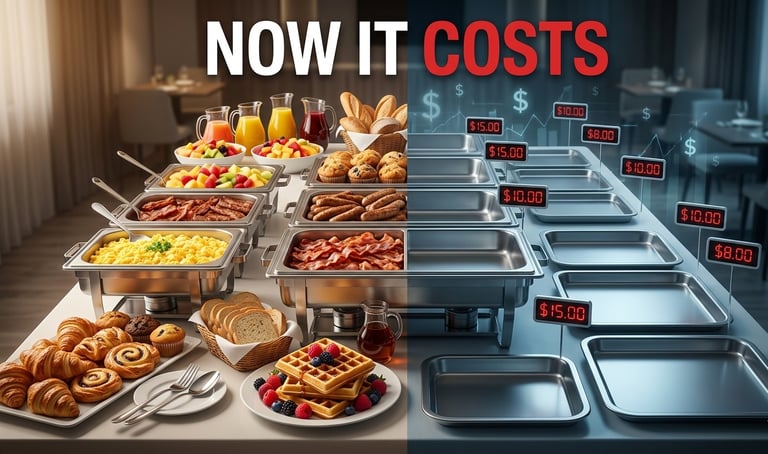
For decades, the free hotel breakfast was untouchable. Waffle irons. Scrambled eggs. Self-serve cereal. Burned coffee in silver dispensers. A chaotic, carb-heavy ritual that became part of the American travel contract.
You book the room.
You get the breakfast.
Now that contract is being renegotiated. And the reason isn’t eggs. It’s economics.
The Sacred Cow That Never Made Financial Sense
Free breakfast was never really “free.” It was a loyalty subsidy. Operators quietly absorbed:
Food costs
Labor
Waste
Equipment
Real estate allocation
Boutique operators estimate breakfast can siphon off 5–7% of total hotel revenue once labor is included. That’s massive in an industry where margins are already thin. For years, brands justified it as:
A loyalty driver
A booking differentiator
A brand signature
But once something shifts from “delight” to “expectation,” it becomes a liability. And we’ve reached that point.
The K-Shaped Economy Hits Hospitality
According to Marriott International CEO Anthony Capuano, travel is living inside a K-shaped economy:
High-income consumers are still spending aggressively on experiences.
Value-conscious travelers are scrutinizing every line item.
Luxury is thriving. Midscale is squeezed. That split matters. Because breakfast means something very different at opposite ends of the market.
Luxury Can Charge for Eggs Benedict
At the top tier, removing free breakfast is easier. Affluent guests:
Expect curated dining
Tolerate à la carte pricing
Often expense meals
Value ambiance over waffles
For them, swapping complimentary breakfast for loyalty points or credits isn’t existential. It’s repositioning. That’s why changes at brands like Hyatt Place don’t immediately spark mass revolt. Upscale customers have more elasticity.
Midscale Can’t Afford to Lose It
Now look at limited-service and upper-midscale brands. At places like Holiday Inn Express or Hampton Inn, breakfast isn’t a perk. It’s part of the math. Families calculate:
Room rate
Parking
Resort fees
Food costs
A “free” breakfast offsets eating out. For many middle-income travelers, it makes the property competitive. Remove it and the value equation collapses. In JD Power data, nearly half of midscale guests call complimentary breakfast a “need-to-have,” not a nice-to-have.” That’s dangerous territory. Because perceived value often matters more than operational margins.
The Quiet Shift Isn’t Elimination, It’s Segmentation
Hotels aren’t ripping out waffle irons overnight. They’re experimenting with:
Grab-and-go options
Breakfast credits
Tier-based inclusion
Loyalty-only access
Room-only vs breakfast-included pricing
This is classic revenue management strategy:
Unbundle. Reprice. Reframe.
Make breakfast visible in the pricing architecture instead of burying it. The danger? When you unbundle something that guests psychologically consider part of the base product, you trigger loss aversion. And loss aversion is powerful.
Why Owners Are Pushing Back Now
Franchisees and property owners are under pressure:
Labor costs are up
Food inflation is volatile
Housekeeping standards have shifted
Brand mandates remain rigid
Breakfast is one of the few levers they can realistically pull. Independent operators breaking away from major brands often eliminate free breakfast immediately. Freed from corporate standards, they reclaim that 5–7% margin. That tells you something. When given optionality, many owners drop it.
The Emotional Cost No Spreadsheet Captures
Here’s what’s easy to miss in the financial modeling: Breakfast is ritual.
Parents remember it.
Kids look forward to it.
Business travelers rely on it.
It signals hospitality. When hotels cut toiletries or reduce housekeeping frequency, guests notice — but they adapt. When they cut breakfast, they feel it. Because it changes the emotional texture of travel.
The Strategic Endgame
Expect bifurcation.
Luxury:
Paid, elevated, experiential breakfast
Credits over buffets
Fewer inclusions, higher ADR
Midscale:
Leaner buffets
More automation
More grab-and-go
Tighter cost controls
Budget tiers will likely cling to free breakfast longest because it’s their clearest value signal. This isn’t about eggs. It’s about margin defense in a K-shaped economy.
The Real Question
Hotels are asking: Does breakfast drive 5% more bookings?
Travelers are asking: Is this still a good deal?
Who wins that tension determines whether the waffle iron survives the decade. Because once a “free” feature becomes a line item, it rarely goes back.
Contact
Questions? Reach out anytime.
© 2025 BizSphere. All rights reserved.