
Big Tech’s Newest Revenue Stream? Your Childhood.
by Divya Kolmi
2/25/20263 min read
For years, Silicon Valley told us a comforting lie:
Storage is free.
Upload everything.
We’ll keep it safe forever.
Now that lie is unraveling. From Google to Apple to Snap Inc. and Shutterfly, companies are tightening free storage limits and nudging users toward paid subscriptions. What used to be a perk is now a recurring bill. And here’s the uncomfortable truth: this was always the plan.
The Bait: Free Storage
Big Tech didn’t offer free storage out of generosity. It was a lock-in strategy. Upload your:
Baby photos
Wedding albums
Tax returns
Personal documents
Once your life is embedded inside an ecosystem, switching becomes painful — sometimes practically impossible. Free storage wasn’t a feature. It was customer acquisition.
Monetize Dependency
Now those same companies are pouring hundreds of billions into AI infrastructure. Parent companies like Alphabet Inc. and Amazon are racing to build data centers and train large language models.
AI isn’t cheap. So where does the steady, predictable cash flow come from?
Subscriptions.
Cloud storage is perfect:
High margin
Recurring revenue
Emotionally sticky
When your entire digital history is sitting on a server, you don’t comparison shop. You pay. That’s pricing power created by emotional leverage.
The Psychological Trap
This isn’t Netflix. It’s not music streaming. It’s your family archive. Deletion warnings feel existential. Consumers report confusion, lockouts, and anxiety around billing changes. And even if companies provide notice, the power imbalance is obvious.
You can’t realistically migrate 20,000 photos overnight. You can’t easily recreate lost memories.
When something becomes essential and switching costs are extreme, companies gain structural control. That’s not innovation. That’s entrenchment.
AI Is Being Subsidized by Your Storage Bill
While consumers are told this is “basic supply and demand,” the broader picture is more revealing. Tech giants are spending aggressively on AI infrastructure. At the same time, they are:
Reducing free tiers
Raising storage prices
Expanding subscription bundles
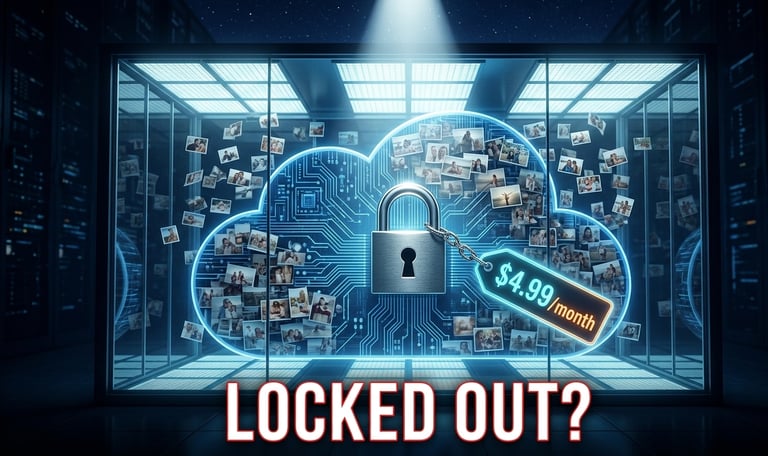
Your $4.99 per month may seem small. Multiply it across hundreds of millions of users and it becomes a financing engine. Consumers are quietly underwriting Big Tech’s AI ambitions. The same companies that once lured users with free abundance are now monetizing the very dependency they engineered.
The Illusion of Ownership
There’s also a deeper philosophical shift happening. We used to own photo albums, hard drives, and printed memories. Now we rent access to our own lives.
Miss a payment?
Violate a policy?
Lose an account?
Your “ownership” evaporates. This is the subscription-ization of personal history. And it’s happening so gradually that most people don’t question it.
Is This Just Capitalism or Something More?
Defenders will say:
Data centers cost money.
Electricity isn’t free.
Storage was never sustainable long term.
All true. But what’s troubling isn’t the pricing. It’s the asymmetry. Companies built ecosystems designed to maximize dependency. They normalized digital hoarding by removing friction. Now they are reintroducing friction in the form of fees once users are locked in. That’s not market evolution. That’s strategic enclosure.
The Bigger Risk
When a handful of companies control:
Your communications
Your documents
Your memories
Your backups
They control more than infrastructure. They control continuity. Today it’s storage caps. Tomorrow it could be algorithmic prioritization of which memories surface, which accounts are flagged, or which users get bundled discounts tied to other services. When life becomes platform-bound, power centralizes.
This isn’t about $5 per month. It’s about who owns your past. Big Tech convinced us that infinite storage was the future. In reality, it was phase one of a long-term monetization strategy. The price of your memories isn’t just rising.
It’s compounding.
And the more we depend on these platforms, the less negotiating power we have. The question isn’t whether storage should cost money. The question is whether we’re comfortable letting a few corporations sit between us and our own history.
Contact
Questions? Reach out anytime.
© 2025 BizSphere. All rights reserved.