
Competitive Rivalry in Action: Amazon vs Walmart, Apple vs Samsung, Netflix vs Disney+
by Divya Kolmi
2/10/20264 min read


Most people think rivalry means “two companies selling similar products.” That’s lazy thinking. Real competitive rivalry is about how firms fight for customers, attention, and share of wallet, often in very different ways.
Michael Porter was clear: customer value is always defined relative to rivals. You are never competing against the market; you are competing against specific alternatives in the customer’s mind.
The easiest way to understand this is through real rivalries.




Amazon vs Walmart: Competing for the Same Customer, Differently
At first glance, Amazon and Walmart appear to be fighting the same battle: retail dominance. But strategically, this rivalry is less about price and more about control of the customer journey.
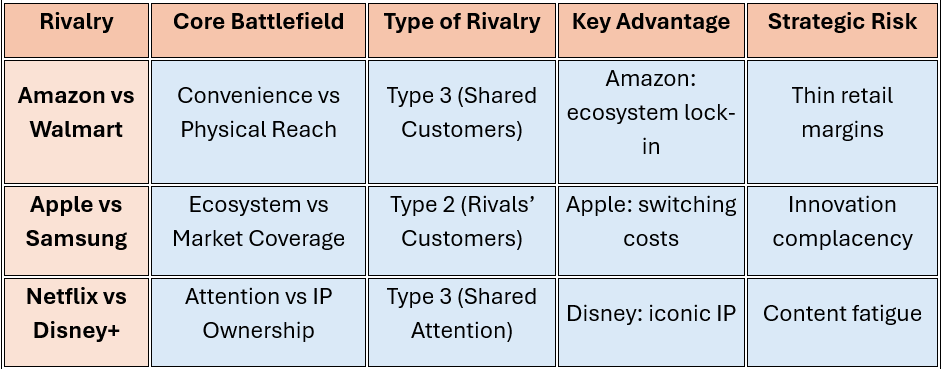
Amazon’s strategy is built around convenience and ecosystem lock-in. Prime is not just a subscription; it’s a switching cost disguised as a benefit. Free shipping, Prime Video, exclusive deals, and now AI-driven recommendations all work together to keep customers inside Amazon’s universe. This is a classic Type 3 rivalry, competing for a larger share of spending from customers who already shop everywhere.
Walmart, on the other hand, plays a hybrid game. It competes for potential customers in underserved physical locations while simultaneously trying to claw back digital share through Walmart+, curbside pickup, and aggressive pricing. Walmart’s edge isn’t technology, it’s logistics density and physical reach.
The strategic lesson here is simple:
Amazon monetizes loyalty. Walmart monetizes access.
They’re fighting the same war using entirely different weapons.




Apple vs Samsung: Rivalry Built on Differentiation, Not Price
Apple and Samsung sell similar products, but they don’t compete on the same dimensions, and that’s exactly why this rivalry is so powerful.
Apple’s advantage lies in vertical integration and brand-driven switching costs. Once a customer buys into the Apple ecosystem - iPhone, AirPods, MacBook, iCloud, leaving becomes cognitively and financially expensive. This makes Apple a master of Type 2 rivalry, where the goal is not to steal customers aggressively, but to make leaving feel irrational.
Samsung takes a broader, more aggressive market-coverage approach. It competes across price tiers, regions, and hardware variations. Instead of locking customers in, Samsung floods the market with options. This allows it to capture customers Apple will never reach, especially in price-sensitive and emerging markets.
Apple wins by deepening relationships.
Samsung wins by widening the battlefield.
This rivalry proves that competitive advantage doesn’t require winning every customer, only the right ones.




Netflix vs Disney+: Content vs Ecosystem Warfare
Netflix vs Disney+ is often described as a “streaming war,” but that framing misses the strategic depth of the rivalry.
Netflix competes almost entirely on content velocity and personalization. Its advantage lies in data, what people watch, when they quit, what keeps them hooked. Netflix doesn’t just create shows; it optimizes attention. This makes it a strong Type 3 competitor, constantly fighting for more viewing hours from customers who subscribe to multiple platforms.
Disney+, however, doesn’t need to win time - it wins emotional ownership. Disney owns IP that spans generations: Marvel, Star Wars, Pixar. The platform itself is only one node in a larger ecosystem that includes merchandise, theme parks, movies, and licensing.
Netflix fights to stay relevant every month.
Disney fights to stay unforgettable for decades.
Strategically, Netflix must keep running. Disney can afford to walk slowly.
The Bigger Strategy Insight Most People Miss
These rivalries reveal something critical: not all competition is about beating your rival head-on.
Amazon doesn’t need Walmart to fail.
Apple doesn’t need Samsung to disappear.
Netflix doesn’t need Disney+ to shut down.
They just need to win their version of the game.
That’s the essence of competitive strategy - understanding what kind of rivalry you’re in and designing your moves accordingly. Companies that misunderstand their rivalry type often overspend, overreact, or chase the wrong metrics.
And that’s usually how market leaders fall.
Explore More Business Articles
Contact
Questions? Reach out anytime.
© 2025 BizSphere. All rights reserved.