Why Every Leader Needs the PESTLE Framework to Spot Hidden Risks and Opportunities
by Divya Kolmi
1/7/20262 min read
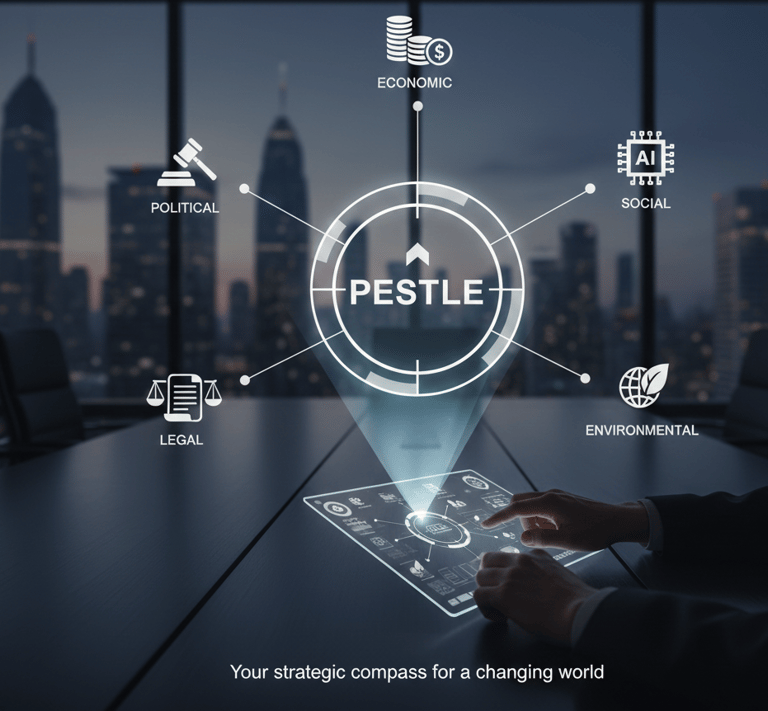
In today's fast-paced business world, understanding the forces shaping your organization is more critical than ever. It's not enough to just look at your direct competitors or internal operations. True strategic foresight comes from grasping the wider environment in which your business operates. This is precisely where the PESTLE framework becomes an invaluable tool. It’s a systematic way to scan the horizon for the big, external factors that can either propel your success or derail your best-laid plans.
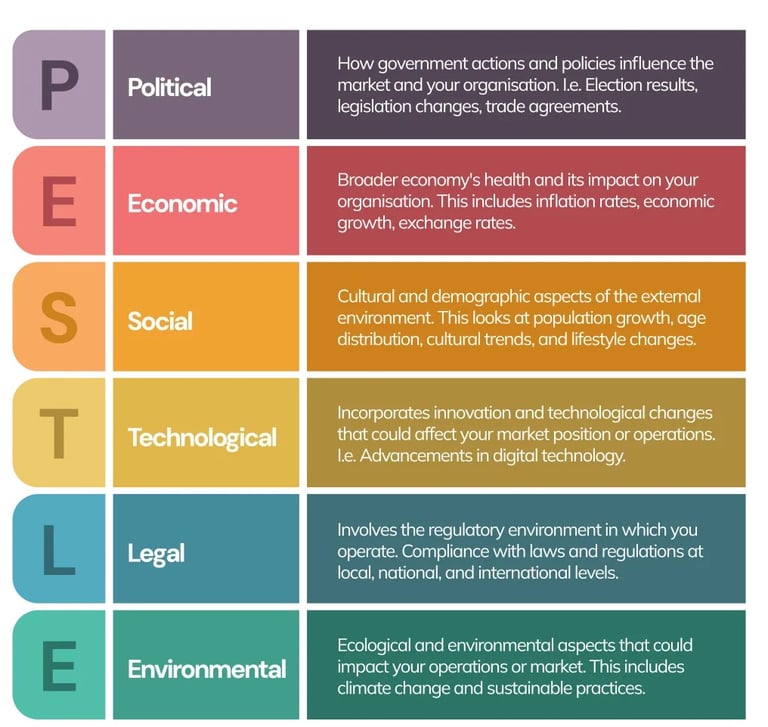
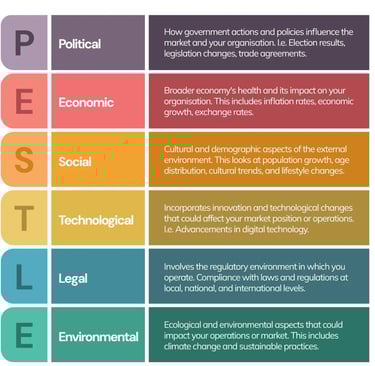
PESTLE stands for Political, Economic, Social, Technological, Legal, and Environmental factors. Each element represents a broad category of external influence that can significantly impact any organization. By systematically analyzing these areas, leaders can move beyond reactive decision-making to proactive strategy. This isn't just an academic exercise; it's a practical blueprint for seeing around corners and anticipating shifts before they become crises or missed opportunities.
Let's break down each component and how it applies to real-world scenarios:
Political Factors: These include government policies, regulations, political stability, trade agreements, and tax policies. A shift in government leadership, for instance, can lead to dramatic changes in industry subsidies or regulatory oversight.
Economic Factors: This category covers interest rates, inflation, exchange rates, economic growth, and consumer spending power. A rise in interest rates, for example, might make it more expensive for customers to borrow money, directly impacting sales for businesses reliant on consumer credit.
Social Factors: Demographics, cultural trends, lifestyle changes, consumer attitudes, and public opinion fall into this bucket. Consider how the growing demand for sustainable products has forced countless companies to rethink their supply chains and marketing strategies.
Technological Factors: This is arguably the most dynamic area, encompassing automation, AI, new materials, and digital infrastructure. The rapid adoption of e-commerce platforms during recent years completely reshaped retail, showing how quickly technological shifts can become essential for survival.
Legal Factors: Laws related to employment, consumer protection, data privacy (like GDPR), health and safety, and competition are crucial. A new data privacy law, for instance, can force a company to overhaul its entire data handling process.
Environmental Factors: These include climate change, weather patterns, resource availability, sustainability trends, and environmental regulations. Companies in industries like agriculture or tourism are directly impacted by changing climate patterns and new carbon emission standards.
The true power of PESTLE lies in its interconnectedness. Rarely does a single factor operate in isolation. For example, a new environmental regulation (Environmental/Legal) might be driven by changing social attitudes (Social), creating new opportunities for technological innovation (Technological), and potentially impacting economic growth in certain sectors (Economic). By mapping these connections, businesses can develop strategies that are not only robust but also adaptive.
The PESTLE framework is more than just an analytical tool; it's a strategic compass for navigating a constantly evolving world. It empowers leaders to think holistically, to move beyond immediate concerns, and to build organizations that are resilient to external shocks while being agile enough to seize emerging opportunities. Integrating PESTLE into your strategic planning isn't just good practice; it's essential for long-term relevance and success.
Explore More Business Articles
DEI at Microsoft Case Study
Contact
Questions? Reach out anytime.
© 2025 BizSphere. All rights reserved.