
Google’s Minnesota Data Center Is Not About AI - It’s About Energy Control
by Divya Kolmi
2/24/20263 min read
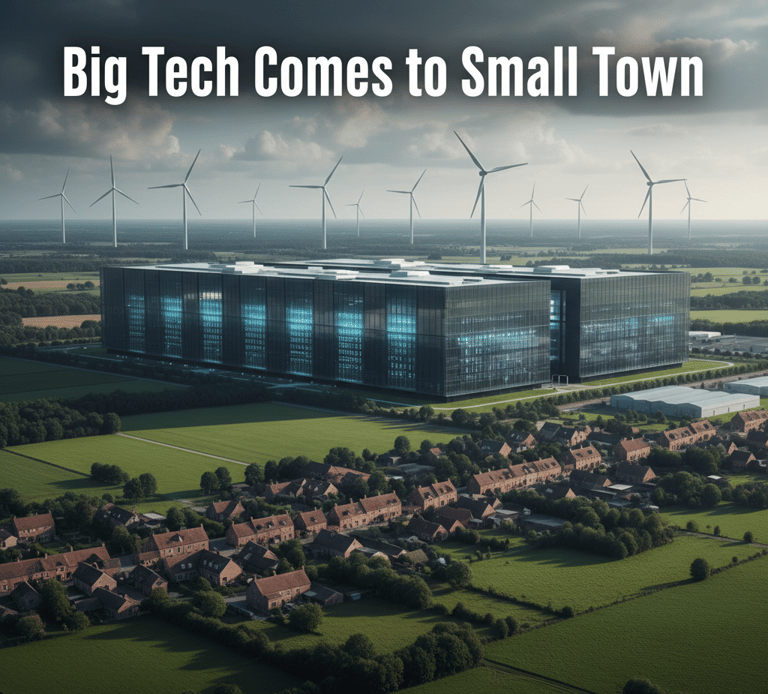
At first glance, Google’s decision to build a new data center in Pine Island, Minnesota looks like another AI expansion story. It’s not.
It’s an energy strategy story. The headline numbers tell you everything you need to know:
1,900 megawatts of new renewable energy
480-acre site
Wind, solar, and battery storage
A custom tariff structure
Google paying for transmission infrastructure
This is not just infrastructure expansion. It’s vertical integration of power risk.
The Real Constraint on AI Is Not Chips - It’s Electricity
AI workloads are exploding. Cloud demand is accelerating. Hyperscale data centers are becoming electricity-intensive industrial operations. The bottleneck isn’t just GPUs. It’s grid capacity.
Across the U.S., data centers are facing political blowback for driving up electricity prices and straining local grids. Communities are questioning whether they’re subsidizing trillion-dollar tech companies. Google’s Minnesota move preemptively addresses that tension.
By agreeing to fund new generation, transmission, and grid upgrades - and by paying a premium under a special tariff - Google is attempting to neutralize the “ratepayer backlash” narrative. Strategically, that’s smart.
This Is Risk Mitigation Disguised as Sustainability
The renewable package - 1,400 MW wind, 200 MW solar, 300 MW battery - is substantial. But this isn’t just about ESG branding. It’s about:
Long-term energy price certainty
Insulating AI infrastructure from fossil fuel volatility
Regulatory goodwill
Political insulation
Energy is becoming a competitive moat. Companies that secure clean, dedicated, scalable power win. Those that rely on constrained grids face permitting delays, public opposition, and reputational risk. Google is buying optionality.
Why Minnesota?
Minnesota is not Northern Virginia. It’s not Texas. It’s not Arizona. Which is precisely the point. Traditional data center hubs are becoming saturated. Land is expensive. Transmission capacity is limited. Community resistance is growing.
Pine Island - population ~4,000 - represents a new wave of hyperscale geography:
Rural land availability
Political support via tax incentives
Renewable resource potential
Lower congestion risk
This is geographic arbitrage. Big Tech is quietly moving into second-tier markets before they become expensive.
The Community Tradeoff
Here’s where it gets complicated. The city expects over $130 million in tax revenue. That’s transformative for a small town.
But residents are worried about:
Water use for cooling
Environmental impact
Long-term grid strain
Rising electricity costs
Google’s promise to cover infrastructure costs is meant to defuse that. But politically, perception matters more than spreadsheets.
Across the U.S., data centers are increasingly seen as invisible industrial facilities that consume enormous resources while creating relatively few permanent jobs. This is the new social license battle for AI infrastructure.
The Strategic Signal to Investors
This deal sends three signals:
1. AI growth will require power market innovation.
Custom tariffs, co-investment in generation, transmission guarantees - this is becoming standard practice.
2. Renewable energy is now industrial infrastructure.
Wind, solar, and storage are no longer climate accessories. They are operational necessities for compute.
3. Hyperscalers are becoming quasi-utilities.
When tech firms directly influence grid buildouts, they’re not just customers - they’re system architects. That’s a structural shift.
The Bigger Picture: The AI-Energy Nexus
We are entering a phase where:
AI expansion
Electric grid expansion.
The companies that master this nexus will dominate the next decade.
Google isn’t just building a data center in Minnesota. It’s building a template:
Secure land early
Lock in renewables
Pay for transmission
Structure tariffs to avoid backlash
Frame it as clean energy acceleration
Expect others to follow.
This project is not primarily about Pine Island. It’s about the future of infrastructure power politics.
AI is energy-intensive.
Energy is political.
Therefore, AI is political.
Google understands that the next competitive frontier isn’t just model performance. It’s power access. And Minnesota is just the beginning.
Contact
Questions? Reach out anytime.
© 2025 BizSphere. All rights reserved.